For AI startups, standing out on model capabilities alone can be difficult. Helping developers achieve a small, concrete result gives them a practical reason to try a company’s technology.
A working classifier, a useful coding tool, or a model running on someone’s phone gives potential users something tangible to experiment with, and a reason to remember the provider.
Together AI’s recent “How to train your own Jev for $17” tutorial illustrates this approach. It takes interest in Jev-style classification and turns it into a reproducible project: fine-tune a model and deploy an endpoint. The tutorial uses Together’s cloud for training and inference. Its marketing strength is the close connection between learning something useful and experiencing the company’s paid platform.
A related approach is to make local inference easy to try. Developers can test a model on their own hardware, explore its limitations, and incorporate it into applications they control. Liquid AI pairs Apollo, its local AI app, with LEAP, its developer platform. Developers can try the models, build with the SDK, and join community activities such as office hours and competitions. Community activity can bring more developers into the top of the funnel through shared projects, tutorials, and recommendations, while documentation and support help them get started.
Google follows a similar pattern with FunctionGemma. Alongside the small function-calling model, it provides interactive demonstrations and a cookbook for training a specialized agent and loading it onto a mobile device. That gives developers a manageable starting point and a clear next step.
The GTM opportunity lies in helping developers reach that first useful result. A developer who gets something working gains practical familiarity with the technology. Adapting it to a personal project creates a reason to return. Sharing a demo, publishing a tutorial, or helping another developer can extend the provider’s visibility through work the community finds useful.
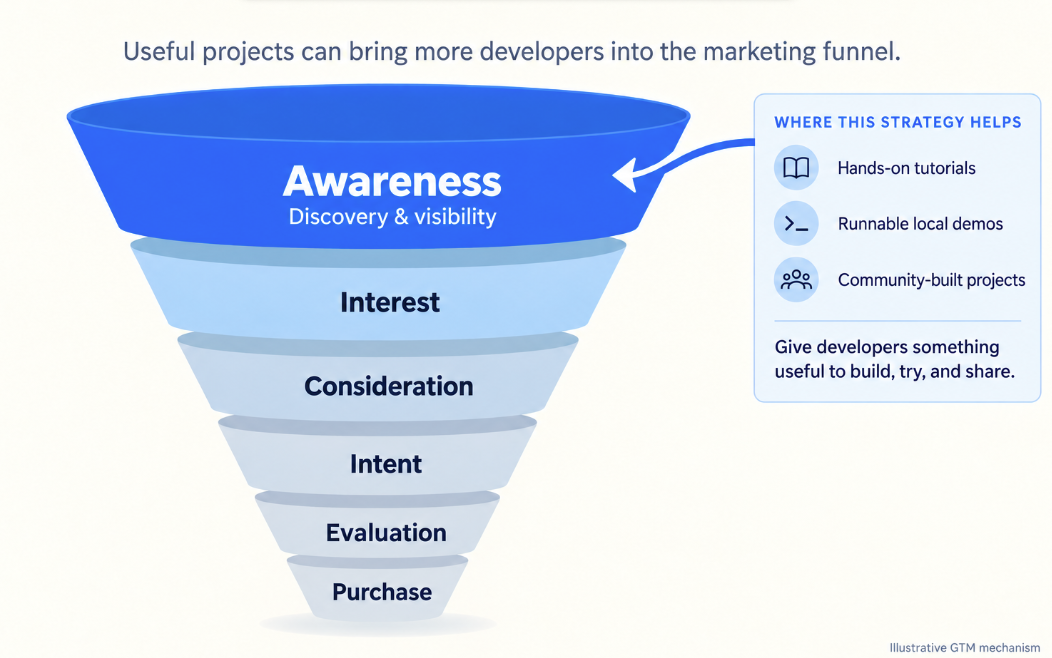
This also raises the standard for developer marketing. The example needs to work and the setup must be achievable.
These launches demonstrate the approach, but they do not establish how much additional engagement or revenue it generates. Downloads and completed tutorials indicate interest and initial use. For labs seeking attention in a crowded market, helping someone build a useful prototype can be a credible starting point.