Every time someone frames BNPL as “fintech lending,” I think they’re looking at an incomplete picture. The interesting question about BNPL has never been “is this sustainable credit?” It’s always been: why are merchants paying for it? The merchant usually pays 3-7% of GMV to the BNPL provider.
Example transaction:
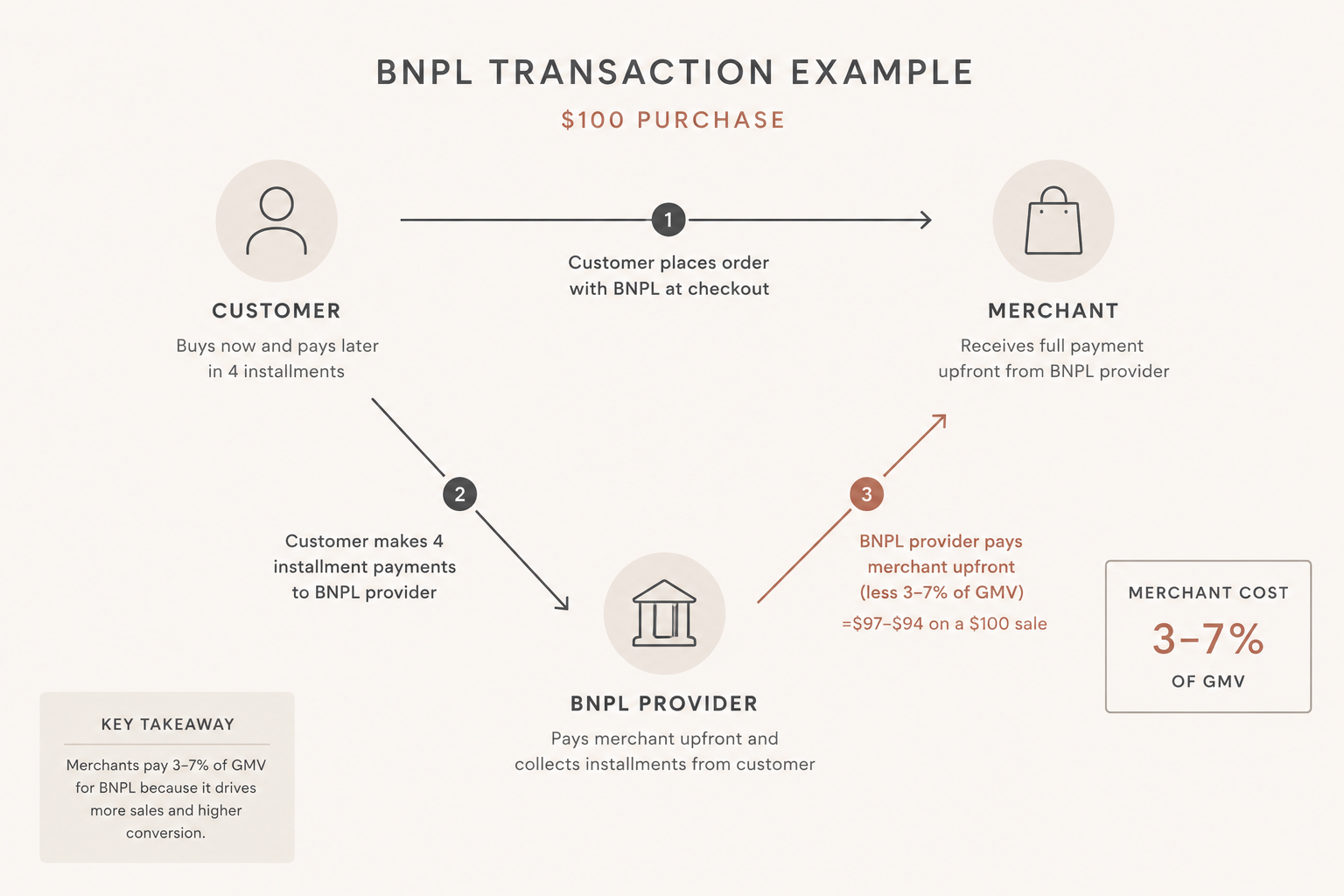
The Mechanism
A recent randomized controlled trial published in the Journal of Financial Economics (Berg, Burg, Keil, Puri, 2025) found that simply offering BNPL as a payment option increased sales by 20% for a German e-commerce furniture retailer. One group of customers saw BNPL at checkout, the other did not.
That 20% increase was disproportionately driven by low-creditworthiness customers. Customers at the 10th credit score percentile were two to three times more responsive to BNPL than customers at the 90th percentile. High-credit customers bought anyway. Low-credit customers needed the BNPL nudge.
Why? Because the zero-interest loan embedded in BNPL is worth more to a poor-credit customer than to a rich one. A customer with a 720+ FICO can get a credit card, a personal loan, or 15 other forms of cheap credit. A customer with a 580 FICO cannot. The 0% interest rate on a BNPL product is, for them, a massive effective subsidy. Their willingness-to-pay for the underlying product is lower, but the loan subsidy bridges the gap.
This is a second-degree price discrimination, which is charging effectively different prices to customers with different willingness-to-pay without explicitly labeling them. Except the merchant isn’t giving a coupon or a sale. They’re subsidizing the loan and letting the math do the work. The high-credit customer pays full price.
The merchant subsidizes the zero-interest loan. That is the crux. Not the consumer. This is what separates BNPL structurally from a credit card, where the consumer pays interest according to their own creditworthiness. In BNPL, the merchant absorbs that cost and recoups it through higher sales volume. High-creditworthiness customers effectively cross-subsidize low-creditworthiness customers.
The Underwriting Is Really Product Pricing
The merchant’s BNPL approval function is credit risk management and profit margin management. The study found that merchants are more likely to approve BNPL for customers buying high-margin products. This makes complete sense: if you’re selling a sofa at a 60% gross margin, you can absorb a 2–3% default cost and still come out ahead. If you’re selling a commodity at a 12% margin, you can’t.
The BNPL approval algorithm is therefore doing something more sophisticated than a traditional credit score. It’s solving:
Should I offer this specific customer a zero-interest loan on this specific product at this specific margin, given their estimated default probability?
It is pricing the product dynamically. The digital footprints, such as device type, cart composition, time of checkout, location, feed directly into this. Customers using Apple devices have statistically higher credit scores. It is a noisy but real proxy for creditworthiness.
The entire model only works because e-commerce produces this credit sale at scale. The same merchant in the study offered zero customers BNPL in its physical stores because the scoring and operational infrastructure didn’t exist to run the model profitably offline. Technology is load-bearing here, which instrumental in creating a synthetic credit-score proxy.
Market Segmentation: Learnings from 2026 Stripe Sessions
At Stripe Sessions 2026, I saw that BNPL providers are carving out distinct customer and merchant niches, and the market is self-organizing around them faster than most people expected.
Zip (formerly Quadpay in the US) is explicitly targeting sub-650 FICO customers, who are the underbanked, the credit-invisible, the people credit cards have historically excluded. Their merchant mix reflects this: value retail, everyday categories, lower average order values. Their product is a credit access product as much as a price discrimination tool. They’re operating in a different risk regime.
Klarna and Affirm are increasingly going upmarket. Affirm’s partnerships, such as Peloton, Amazon, and Apple, tell you everything. Their average borrower isn’t credit-invisible; they’re someone who could revolve on a credit card but chooses not to. Affirm explicitly competes with credit card revolving debt. That’s a more elegant form of the same price discrimination mechanism involving extracting surplus from customers who are sensitive to financing costs, not credit risk per se.
And then there’s merchant-side segmentation. General merchandise and electronics trend toward Affirm and Klarna. Lower-ticket, high-frequency retail skews toward Zip and Sezzle. Healthcare is a different beast entirely with Scratchpay and CareCredit because the willingness-to-pay dynamics in medical spending are structurally different from discretionary retail. A patient will pay almost anything for a root canal. The point is that BNPL right now is undergoing vertical specialization, not horizontal consumer brand scale.
The Cost Structure
The study provides an unusually clean cost breakdown because the merchant ran BNPL entirely in-house.
Variable costs: ~2.1% of transaction volume (1.17% unrecovered defaults + 0.89% cost of capital at 7% p.a. over a 48-day average loan). Strikingly, Klarna’s 2023 reported costs work out to 2.02%, almost identical.
The displacement costs: when BNPL becomes available, PayPal usage drops 24 percentage points, credit card usage drops 5 points. Some of those customers would have bought anyway via cheaper payment methods. Now they’re buying via BNPL, which costs the merchant more. That displacement raises the blended transaction cost from 0.93% to 1.47% per €100 of existing sales.
But the incremental margin on new sales unlocked by BNPL is roughly €3.3 per €100 of cart value. And, assuming a 20% product margin overwhelms that displacement cost. The economics work. And they work best in the middle of the credit spectrum: high enough credit that default rates are manageable, low enough that the BNPL subsidy meaningfully moves the purchase decision. The profitability curve is an inverted U across credit scores.
What kills the model? Sustained high interest rates raise the cost-of-capital component (doubling the rate from 7% to 14% p.a. raises variable costs by ~0.85%). A severe recession spikes defaults. The paper models a GFC-scale credit card delinquency shock and concludes it would make BNPL unprofitable only at the very bottom of the credit spectrum and not across the board. The model is more resilient than critics assumed during the 2022 rate-hike panic.
What This Means If You’re Building or Investing in FinTech
For BNPL founders and operators: The defensible moat is the underwriting model and the merchant relationship. Klarna’s consumer brand is nice; what’s actually defensible is their real-time credit scoring infrastructure and merchant network density. Build toward vertical depth, not consumer acquisition breadth. The next category winner probably doesn’t call itself BNPL at al; it calls itself embedded finance for [dental/auto/travel/healthcare].
For banks and card networks: BNPL is eating revolving credit from both ends simultaneously, the high-risk end (Zip targeting sub-650 FICO) and the prime end (Affirm competing with credit card revolvers who hate APR).
For merchants evaluating BNPL partners: Affirm’s 2023 annual report candidly tells us that “Merchants have the ability to subsidize and determine the range of interest rates to be paid by their customers.” 78.7% of Klarna’s primary revenue comes from retailer commissions. Model BNPL as a variable pricing mechanism and not a payment processor fee. This will allow merchants to make better decisions about which provider to use, for which SKUs, at which margin thresholds.
For AI/data infrastructure builders: The entire BNPL model runs on real-time inference from digital footprint. The gap between a merchant that can score a customer in 200ms from their cart composition and device fingerprint versus one that can’t determines who gets to offer BNPL profitably. That scoring infrastructure including edge inference, adaptive models, and continuous retraining is the competitive advantage.
Conclusion:
BNPL is a centuries-old economic mechanism price discrimination via vendor financing, which is rebuilt on modern data infrastructure. The theory was formalized in academic literature as early as 1988. What changed in the last decade is that the scoring and operational costs of running it dropped to near zero in e-commerce contexts.
Sources:
Berg, Burg, Keil, Puri — "The Economics of Buy Now, Pay Later: A Merchant's Perspective," Journal of Financial Economics, 2025.
Klarna 2023 Annual Report.
Affirm 2023 Annual Report.
Observations from Stripe Sessions 2026.