Big proponent of being a decent human being. But, what does math have to say about it?
Prisoner’s dilemma is a game where two prisoners are separated in a room and asked to snitch with below consequences.
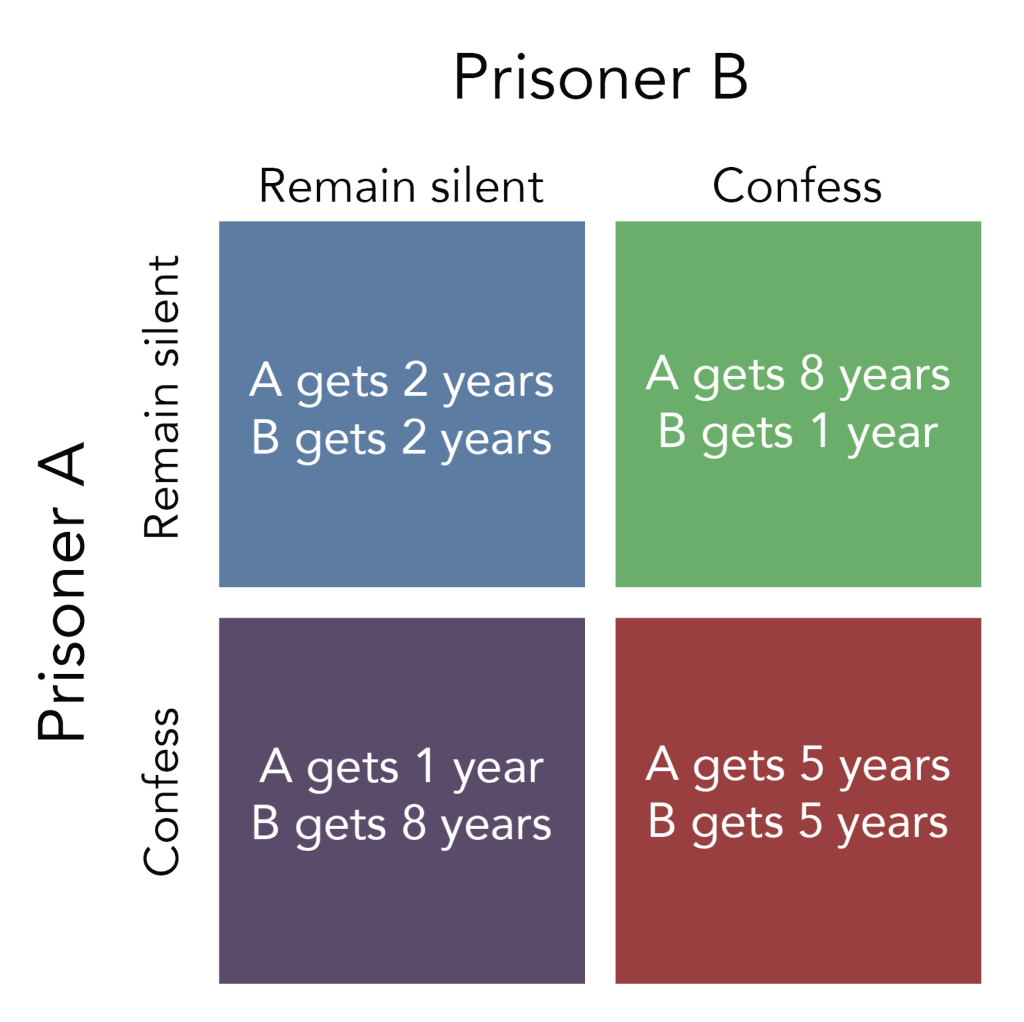
Almost all human interaction can be distilled to a form of prisoner’s dilemma with different payoffs with the below choice:
Defection (Self-Interest): Maximizing immediate personal gain at the expense of the counterparty.
Cooperation (Mutual Growth): Accepting a lower individual payoff to ensure a higher long-term aggregate payoff.
Turns out the best strategy in a single shot game of prisoner’s dilemma is to snitch because it yields a better individual payoff regardless of what the counterparty does. In a single-shot game, there are no future interactions. There is no threat of retaliation and no value in building a reputation.
But, what happens when you are playing series of game, which resembles more with the real world interactions in business, politics, or everyday life dealings?
Robert Axelrod at UMich conducted a series of experiments in 1970s and 80s with variations of prisoner’s dilemma. Most of important of them was the iterated prisoner’s dilemma.
He invited game theory experts from various disciplines like economics, psychology, mathematics, and sociology to submit computer programs that would play against each other in a round-robin format.
The strategies varied from 1000-line complex codes to simplest tit-for-tat. Tit-for-tat won.
Tit-for-tat succeeds because it maximizes long-run expected payoff under uncertainty. It rewards cooperation immediately, punishes defection proportionally, and minimizes losses from prolonged conflict.
The top strategies had following specific behavioral traits:
Be Nice: Never be the first to defect. By starting with cooperation, you signal that you are a reliable counterparty, establishing a basis for mutual trust.
Be Retaliatory: If the other party defects, strike back immediately. You cannot be a “pushover,” or you will be exploited by “nasty” strategies that seek to profit on your account.
Be Forgiving: Once you have retaliated, return to cooperation as soon as the other party does. Do not hold a grudge; the goal is to resume the “win-win” cycle, not to engage in a destructive feud.
Be Clear: Your behavior must be predictable and transparent. Complexity or randomness prevents counterparties from trusting your patterns, which often leads them to default to defection.
As one of the comments on the video below summarizes: "Be nice, be forgiving, but don't be a pushover"
Veritasium video: